My Husband Left Every Evening For Three Years To Help His Uncle. On Our Anniversary, His Wife Told Me Five Words That Made My Blood Run Cold
That was the moment I knew I would not confront him yet.
I needed to see where he went.
The House Across Town
The next evening, Ethan glanced at his phone and sighed in the exact theatrical way he always did.
"Arthur's water heater is leaking. I have to run over."
"Of course," I said. "Drive safely."
He kissed my cheek, picked up his keys, and left.
I counted to twenty after the door clicked shut. Then I grabbed my purse and followed him.
He did not head toward the highway. He did not drive to the older neighborhood where I had always imagined a sick uncle might live.
He crossed town, passed the elementary school, and turned onto a quiet street lined with maple trees.
I parked half a block away and walked closer.
Ethan let himself into a modest yellow house like a man coming home.
That detail nearly broke me before I saw anything else.
He did not knock. He did not hesitate on the porch or glance around like someone visiting in secret. He used his own key, wiped his shoes on the mat, and stepped inside with the tired ease of a husband returning after work.
Just before the door closed, I saw a woman in the entryway. She looked tired in the familiar way people look at the end of a long day. Beside her stood a boy around twelve.
Ethan bent down and kissed the boy on the forehead.
Not like an uncle.
Not like a family friend.
Like a father.
My hand tightened around the trunk of the tree beside me.
Through the front window, I saw an older woman setting plates on the kitchen table. Gray hair pinned back. A strong jaw. Gentle eyes.
I knew her face immediately.
Ethan kept one faded photograph in the bottom drawer of his desk. He said it was his mother, Margaret, the woman who had not spoken to him in years.
Yet there she was, placing dinner on a table in the house my husband visited every night.
I was not watching an affair.
I was watching an entire hidden life.
There was a bicycle tipped in the yard and a school backpack near the front window. Someone had taped a child's drawing to the glass. From where I stood, I could not make out the picture, only the bright crayon sun in the corner.
Those ordinary signs hurt more than any perfume on Ethan's shirt.
He had not been sneaking away to a room that would vanish when he left it. He had been walking into bedtime routines, homework, dinner plates, and a boy who trusted the kiss on his forehead.
The Truth He Had Buried
I drove home without confronting him.
My whole body wanted a fight, but some colder instinct told me to gather the truth first.
So I called Ruth again.
This time, she seemed to be expecting me.
"I hoped you would call back," she said.
Piece by piece, she told me the story Ethan had buried before he ever met me.
Years earlier, he had been with a woman named Lila. She became pregnant. Ethan walked away before their son was born.
His mother, Margaret, was ashamed of him for abandoning the child. She stayed close to Lila and helped raise the boy, even after Ethan pretended to everyone else that the relationship with his mother had been destroyed for some mysterious reason.
Three years ago, Ruth said, Ethan showed up on Lila's doorstep and begged to know his son.
Lila let him in slowly.
She did not know he was married.
She believed he lived far away and visited whenever he could.
"Margaret told me he swore he was trying to make things right," Ruth said. "She wanted to believe her son had finally grown up."
I almost laughed, but there was no humor in me.
He had called abandonment a mistake, called secrecy maturity, and called his nightly disappearances duty. Every woman around him had been handed a different version of Ethan, and each version required someone else to stay silent.
I sat with the phone pressed to my ear, too stunned even to cry.
Ethan had not been torn between duty and marriage. He had been using my trust to keep two women in separate rooms of the same lie.
The Suitcase By The Door
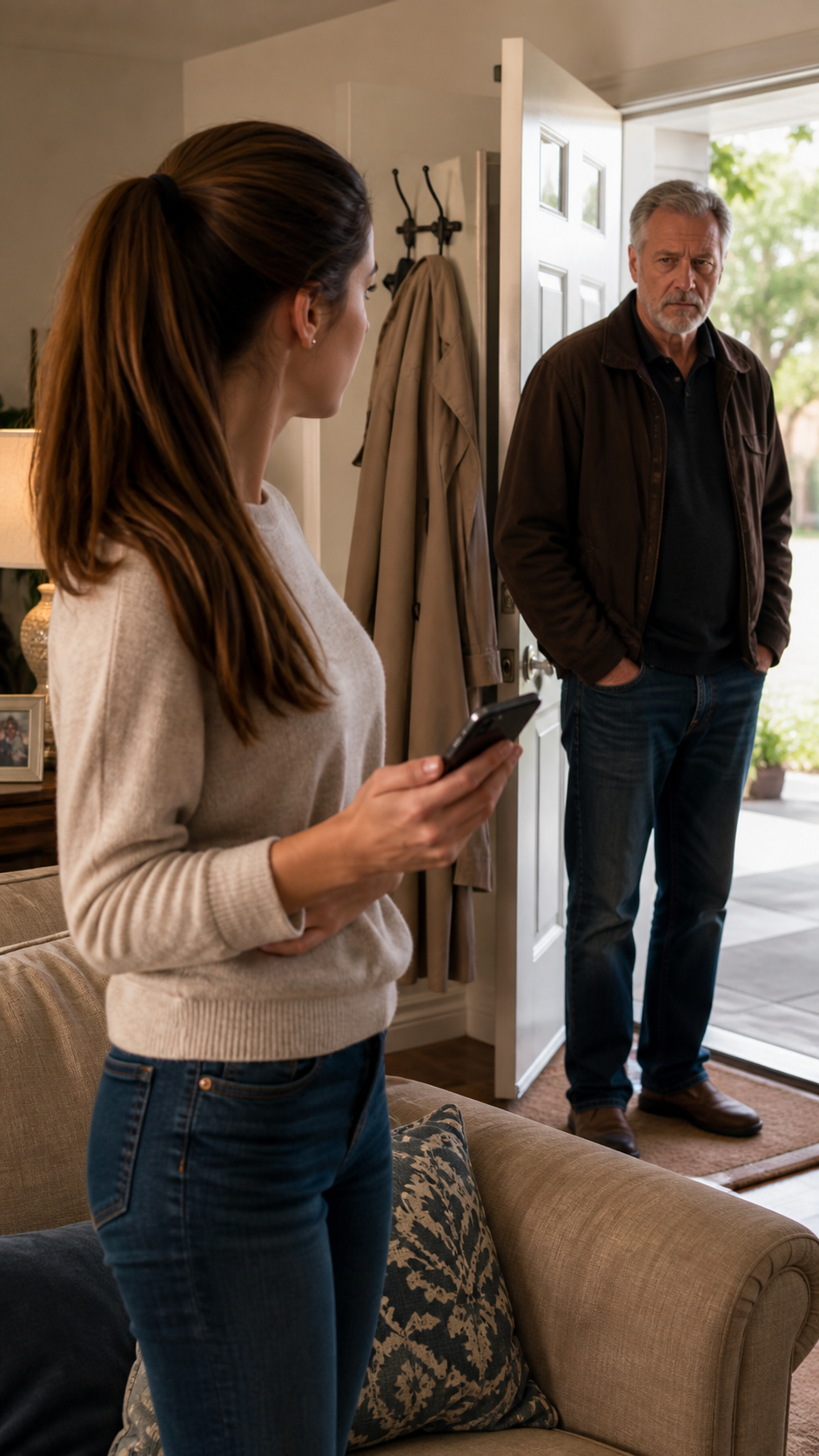
When Ethan came home that night, his suitcase was waiting beside the front door.
He stopped so abruptly his keys clattered against the wood floor.
"Claire, what is this?"
I stood in the hallway, calm in a way I had never felt before.
"I called Arthur's wife."
The color drained from his face.
For the first time in our marriage, no answer came ready.
No burst pipe. No sick uncle. No cat, no dog, no water heater.
Only silence.
"You do not get to keep two women in the dark because honesty makes you uncomfortable," I said. "Lila deserves the truth. I deserve the truth. And your son deserves a father who does not hide him behind a dead man."
"Claire, please. I can explain."
"You had three years to explain."
His eyes moved past me to the suitcase, then to the dining room, then back to my face. I could see him searching for the old path through me, the soft place where I used to doubt myself first.
I did not give it to him.
"Does Lila know about me?" I asked.
He opened his mouth.
That hesitation answered before he did.
I opened the door.
He looked at me as though he expected the woman I used to be to return and save him from the consequences.
She did not.
What I Chose After The Lie
The following week, I filed for divorce.
Several months later, I moved into a small apartment with thin walls, secondhand dishes, and wind chimes I bought for myself.
For the first time in years, the sound did not feel like a performance.
There were evenings when 6:30 still made my body tense.
I would hear a car door outside or keys in the hallway and brace for an excuse that was no longer coming. Healing was not a dramatic doorway I walked through once. It was learning, night after night, that nobody was about to leave me alone at a table and call my pain heartless.
I enrolled in the pottery class I had postponed for a decade. I called my sister, Nora, after two years of silence. She cried when she heard my voice because she had never trusted Ethan and had been waiting for me to come back to myself.
With Ruth's help, I eventually met Lila for coffee.
We did not become friends exactly. We were two women sitting across from each other with the same truth between us, both grieving different versions of the same man.
She deserved better. So did I.
People had admired my marriage because they only saw the porch, the coffee, the repaired light, and the man who smiled in public.
They never saw the empty chair at 6:30.
They never saw how carefully a lie can be polished until it looks like love.
Now I live in a smaller place. It is quieter. It is less impressive from the outside.
But every room in it belongs to the truth.