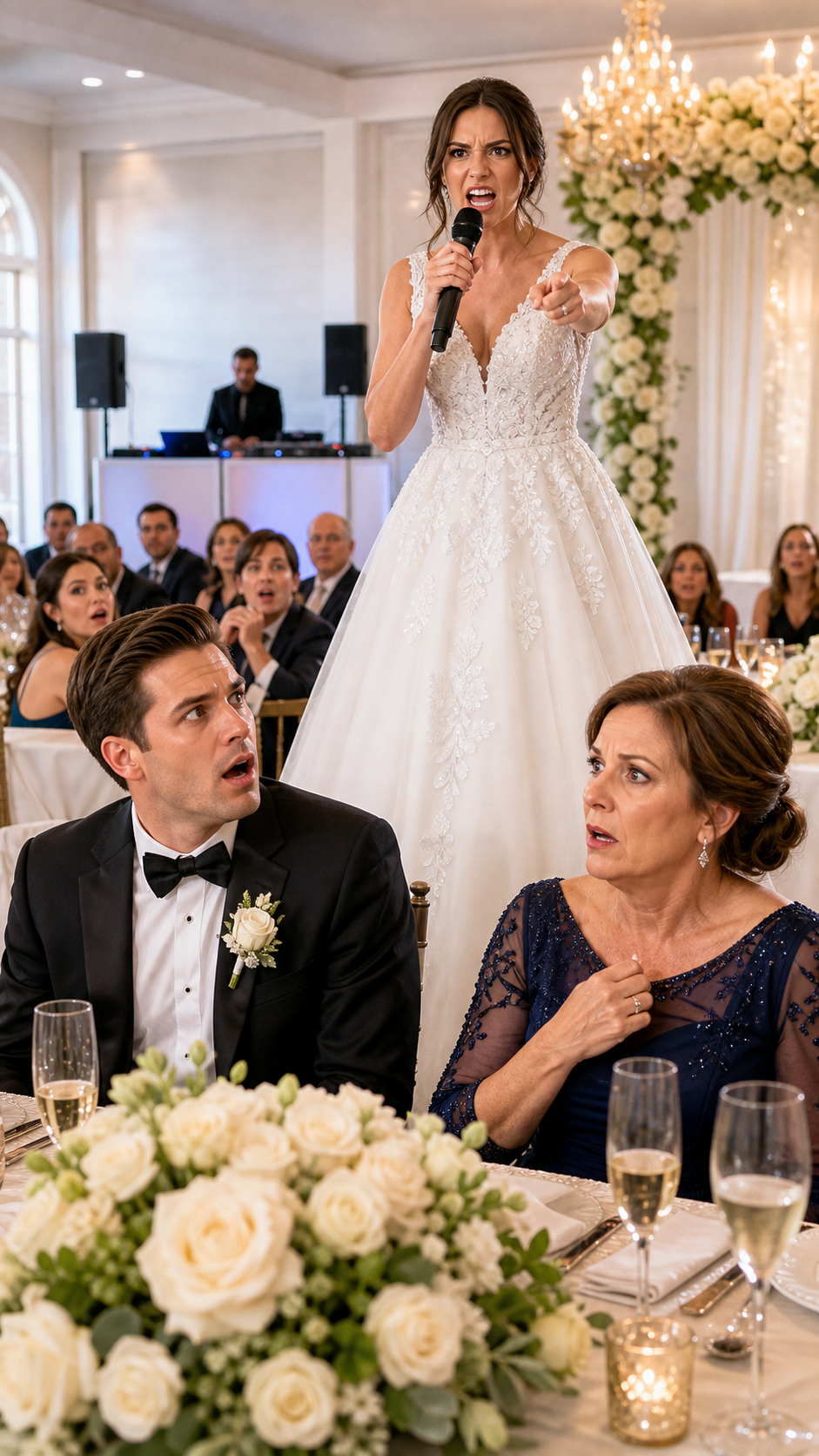
My husband strolled into our divorce hearing hand-in-hand with his mistress, basking in a smug victory he thought he’d bought with forged evidence and stolen wealth. He actually laughed, promising I’d leave the courtroom with nothing. But the exact moment I unbuttoned my silk blouse, the judge’s face drained of color and a suffocating silence gripped the entire room. That was the split second my husband realized his darkest nightmare was about to hit the light.
By Kaleido
The Door Finally Opened
Leave a Reply Cancel reply Your email address will not be published. Required fields are marked * Comment * Name * Email * Website Save my name, email, and website in this browser for the next time I comment.
of 3
I had not seen Matthew in almost three years. Victor had convinced him I was unstable, then convinced me Matthew had given up on me. We became two people standing on opposite sides of a locked door, each believing the other had walked away.
Matthew’s eyes were red. He held a folded letter in his hand. “I came as soon as Nathaniel called,” he said.;
Matthew looked at the scars visible above Nathaniel’s jacket, and grief crossed his face so openly that I had to look away. “I’m sorry,” he whispered. Those two words carried years. I wanted to say it was all right. It was not.
So I said, “I needed you.” His face crumpled. “I know.” “You believed him.” “I did,” he said. “Not because I loved him more. Because believing him meant I didn’t have to imagine I had failed you that badly.”
The honesty hurt. But it opened a door. He handed me the letter. “This came to my office yesterday. No return address.”
Inside was a copy of a bank statement connected to one of Victor’s shell accounts. Beneath it was a handwritten note: Victor did not act alone. Ask who prepared Claire’s evaluations.
My fingers tightened. Nathaniel read the note twice, then looked toward Victor’s table. “Mrs. Whitmore, do you know a Dr. Simon Pierce?” The name moved through me like cold water.
“Yes,” I said. “He was the psychiatrist Victor insisted I see.” Matthew frowned. “The one who wrote those reports?” I nodded. Nathaniel’s expression changed. “His signature appears on the evaluations submitted today.”
“So?” “Dr. Simon Pierce died last year.” The room around me seemed to fade. “But the latest report was dated three months ago,” I whispered. “Yes.”
Nathaniel requested permission to submit the newly received material under seal pending authentication. Mr. Lowell objected, but his objections sounded thinner now. The judge accepted the material for review.
Then she turned to me. “Mrs. Whitmore, before I rule on temporary orders, is there anything you wish to say?” Nathaniel glanced at me. “You don’t have to.” I knew. That was why I stood.
“When I married Victor, I thought marriage meant partnership. I thought if someone loved you, they would want your world to become larger. Mine became smaller. Quietly, then completely.
I stopped answering calls because it was easier than explaining why I sounded afraid. I stopped visiting my family because every visit became an argument afterward. I stopped recognizing myself.”
My voice shook, but it did not break.
“I am not here because I want revenge. I am here because my name is on documents I did not sign. My parents’ company is in danger. My medical history was turned into a weapon.
And somewhere along the way, I began to believe surviving quietly was the same as living.”
I touched my grandmother’s necklace. “It isn’t.” The judge’s eyes softened. “I am asking this court to protect the truth long enough for it to be fully seen.”
When I sat down, Matthew was crying. Mira wiped her eyes. Even Serena looked down at her hands.
Judge Hayes issued her ruling: disputed assets frozen, Victor ordered to surrender company credentials, records preserved, an independent forensic review opened, medical documents sent for authentication,
and the divorce paused pending investigation into fraud.
Victor stood slowly. “You can’t do this.” Judge Hayes’s expression did not change. “I just did.”
There was no applause. Real life rarely gives applause at the right moments. There was only the gavel, the rustle of papers, and my first full breath in years.
The Envelope in the Safe
Outside the courtroom, the hallway felt too bright. Matthew walked beside me as if afraid I might disappear. Mira stood with Nathaniel near the elevators. Serena remained several feet away, speaking quietly to a woman I assumed was her sister.
Victor stood surrounded by attorneys, pale and furious.
He caught my eye once. For the first time, I did not look away. Nathaniel’s phone rang. He listened, then turned slightly from the group. Something in his posture changed. “What happened?” I asked.
“Investigators arrived at Victor’s townhouse with the preservation order. They found the boxes Serena mentioned.” My hand closed around the necklace.
“There are company records, original medical files, and several signed blank letterheads from Dr. Pierce’s office,” Nathaniel said. “But that isn’t all.” The hallway seemed to narrow.
“In Victor’s private safe, they found a sealed envelope addressed to you.” “To me?” He nodded. “It was marked in your mother’s handwriting.” My heart stopped. “My mother died eight years ago.”
Nathaniel looked at the phone, then back at me. “Claire, the envelope contains a marriage certificate.” I stared at him. “It says your mother was legally married to Victor’s father before she married yours.”
For a moment, the courthouse hallway disappeared. Matthew stepped closer. “That can’t be right.”
“I haven’t seen the original yet,” Nathaniel said. “Only a photograph from the investigator. But it appears authentic enough that we need to treat it seriously.” “What was his father’s name?” I asked.
“Charles Whitmore.” Whitmore. I had carried that name my whole life, believing it came from my father’s side, from the business my parents built, from the sign above the workshop door.
Hartwell Home Furnishings. But Victor was a Whitmore too. I had always thought it was coincidence. My father once joked it was fate the day I brought Victor home. Now that memory felt different.
“Mom would have told us,” Matthew said. “Maybe she tried,” I whispered.
Across the hallway, Victor was watching. His face had changed again—not angry now, but alert. When his eyes moved from Nathaniel to me, I saw recognition. He knew exactly what had been found.
Nathaniel said, “We need to leave before anyone tries to pull this into the hallway.” Victor called my name, almost gently. That frightened me more than his fury. “You don’t understand what you’re touching,” he said.
I held my grandmother’s necklace tightly. “Then I suppose I’ll have to learn.” His jaw tightened. “Some things are buried for a reason.” Nathaniel moved between us. “All communications go through counsel.”
Victor’s eyes hardened. “You have no idea what her family did.” Matthew stiffened. “What is that supposed to mean?” But Victor’s lawyer reached him and pulled him away before he could say more.
It was not the look of a man afraid of losing a divorce. It was the look of a man afraid a story older than our marriage was beginning to wake up.
The Photograph
Nathaniel led us into a private conference room. Mira came with us, as did Matthew. Serena did not. The room smelled faintly of coffee and dust. I sat because my knees no longer felt trustworthy.
Matthew sat beside me, close enough that our shoulders almost touched.
For years, that distance had been filled with Victor’s lies. Now my brother was here, real and breathing, his hand resting on the table as if I could take it whenever I wanted.
Nathaniel placed his phone on speaker. “Evan, we’re in a secure room. Tell us exactly what you found.”
The investigator explained that the safe was behind a false panel in Victor’s townhouse study. Inside were passports, banking records, unsigned but notarized transfer forms, and a sealed envelope marked For Claire in my mother’s handwriting.
“What was inside?” Nathaniel asked.
“A marriage certificate dated thirty-six years ago. Grace Eleanor Hart and Charles Raymond Whitmore. Filed in Vermont. There is also what appears to be a dissolution filing from two years later. And a photograph.”
“What photograph?” Matthew asked. “A young Grace standing outside a workshop with Charles Whitmore and another man. The other man appears to be your father, Robert.” Matthew leaned back slowly.
“My father knew him,” he whispered.
The images arrived securely a moment later. The marriage certificate appeared first. The paper was yellowed, the ink faded but legible. My mother’s signature was young but unmistakable. Then the dissolution filing. Then the photograph.
There she was: my mother at perhaps twenty-four, hair pinned back, one hand shading her eyes from the sun. Beside her stood a tall, handsome man I recognized from Victor’s family portraits: Charles Whitmore.
On her other side stood my father, Robert Alden, younger than I had ever seen him, with sawdust on his shirt and a careful distance in his posture.
Behind them hung a wooden sign. Whitmore & Hart Custom Furniture. Not Hartwell Home Furnishings. Whitmore and Hart.
Matthew pointed to the corner of the photograph. A child stood half-hidden near the workshop door. A boy about six or seven. Dark hair. Serious eyes. Victor. My skin prickled.
Victor had not entered my life as a stranger. He had circled back into a story that began before I was born. Nathaniel enlarged the image. On the back, my mother had written a date and four words:
Before Charles took everything. Matthew stood and walked to the window. I did not follow him immediately. I knew that stance. We inherited it from our father, the way he faced away when emotion threatened to become sound.
Mira spoke softly from near the door. “Your mother kept a green cedar box in the upstairs linen closet.” I looked at her. “At the old house?”
Mira nodded. “When Mr. Victor moved your things after you left, he took that box himself. He said it was full of junk papers. I remember because you had asked me about it once.” I closed my eyes.
The green cedar box. My mother’s box.
After she died, I had searched for it more than once. My father said she must have rearranged things during her illness. Matthew thought maybe it went into storage. Victor told me gently that grief made people invent missing objects.
But it had existed. And Victor had taken it. Mira added, “Richard’s mother came to the house once before your wedding.” “My mother was dead before my wedding.” “No,” Mira said gently. “I mean Victor’s mother.”
“Vivian?” Mira nodded. “She asked to speak to you, but Mr. Victor sent her away. He told you a florist had come by mistake. I remember because she was crying in the driveway.” The past shifted again.
Victor’s mother had not attended our wedding. He said she was ill. Later, he said she was unstable. Eventually, he stopped mentioning her. “What did she want?” Nathaniel asked.
Mira folded her hands. “She said Claire should know what happened to Grace.” Matthew turned from the window. “What happened to our mother?” Mira’s eyes filled. “I don’t know. Victor came out before she could say more.”
Nathaniel closed the laptop partway. “We need to find Vivian Whitmore.”
The Yellow House
By late afternoon, I stood outside the courthouse beside Matthew, Mira, and Nathaniel. The sky had turned pewter gray. Reporters gathered at the front steps for another case, their cameras pointed elsewhere. I was grateful.
My life had been exposed enough for one day.
Serena appeared near the side entrance. She approached slowly, both hands visible. “I gave Nathaniel the address of the storage unit,” she said. “Victor rented it under my name. I didn’t know until today what was in it.”
The Door Finally Opened
The Room Went Quiet
The Evidence Came Back
The Truth Moved First
The Last Lie Broke
of 3
The Workshop Key
For years, I asked why Victor chose me only to spend our marriage making me smaller. Now the answer was not romantic failure. It was strategy, entitlement, and control when I did not give him what he wanted.
“He didn’t marry me,” I said softly. “He entered the house.” Nathaniel’s voice gentled. “Claire, I’m sorry.” “Did they find the documents Charles wanted?” “Not yet.”
I looked around my mother’s office. “Maybe Victor never found them because he didn’t understand her.” “What do you mean?” Matthew asked. “My mother wouldn’t hide something valuable in a safe. Safes tell people where to look.”
I stood and walked to the blue ceramic bowl from the kitchen. Rain-colored glaze. My mother’s favorite. I turned it over. On the bottom, beneath the maker’s mark, something had been taped and painted over so carefully it looked like part of the clay.
Using a letter opener, I loosened the edge. A tiny brass key fell into my palm. Attached to it was a strip of paper in my mother’s handwriting. Pretty things survive hands that don’t know their worth.
My grandmother’s phrase. My mother had known it too. Nathaniel was still on the phone. “Claire?” “I found a key.” “To what?” I looked at Matthew. He was already staring toward the workshop behind the house.
The Name Beneath the Name
We crossed the yard with flashlights as evening settled blue and cold around us. The workshop door groaned open. The familiar scent hit me first: sawdust, varnish, metal tools, and time.
For a moment, I saw my father at the workbench, sleeves rolled, teaching me to sand with the grain.
Never against it, Claire. Wood remembers roughness. The workshop had been searched. Drawers hung open. Boxes had been moved. But the long maple workbench remained bolted to the floor, too heavy for anyone to move casually.
I walked to the end where my mother used to sketch designs. A small locked drawer sat beneath the drafting ledge. The brass key fit. Inside was a stack of papers tied with green ribbon.
At the top was the original partnership dissolution agreement. Charles Whitmore had signed away all claims to Whitmore & Hart in exchange for a payout. The signatures were notarized, witnessed, and legal.
Below were documents proving Grace later bought the remaining assets and transferred partial ownership to Robert before incorporating Hartwell Home Furnishings.
Victor’s claim to my parents’ company had no foundation. My knees weakened with relief. Matthew laughed once, breathless. “She saved it.” I touched my mother’s signature. “No. She saved us.”
Beneath the legal papers was a sealed letter addressed to me. Claire. I opened it beneath the workshop light. My darling girl,
If you are reading this, then the past found you despite everything I tried to do. I am sorry. I should have told you about Charles Whitmore, but I wanted your childhood untouched by the ugliness of old mistakes.
Perhaps every mother believes silence can become shelter if she loves fiercely enough.
Charles was my first husband, but he was never my home. He wanted ownership of what others created. Your father, Robert, wanted to build. That was the difference between them.
If Victor has entered your life, listen carefully to your own unease. I saw him once as a boy and once as a young man. Both times, he watched the workshop as if he had been denied an inheritance. Pity can be a dangerous doorway, Claire.
Do not let anyone enter your life simply because you feel sorry for the wound they refuse to heal.
If I am wrong about him, burn this letter and forgive a worried mother. If I am right, remember this: Nothing he takes can change who made you. I pressed the letter to my chest.
Matthew stood quietly beside me, giving my grief room. Nathaniel’s voice came through the phone. “Claire, those documents may protect the company.” “And my mother?” A pause. “They restore her voice.”
The next morning, Nathaniel filed the documents under seal and requested expanded protection over Hartwell Home Furnishings.
Judge Hayes granted emergency preservation of the company and ordered Victor to disclose all records relating to Charles Whitmore, Grace Hart, and Whitmore & Hart Custom Furniture.
Matthew stayed beside me through every meeting. Mira came to the house and made lentil soup as if soup could hold the legal system together. Serena’s attorney contacted Nathaniel with an offer to cooperate fully.
Even Vivian Whitmore, Victor’s mother, was located in a small assisted-living home two counties away.
That evening, I returned alone to the workshop. Not because I wanted solitude, but because I was no longer afraid of it. I placed my grandmother’s necklace in the blue bowl and set my mother’s letter beside it.
Three generations of women, each leaving something behind for the next to find. A car pulled into the gravel drive. For a second, fear moved through me automatically. Then Matthew called from the porch, “It’s me.”
“So did I.” He looked at me. “Then maybe we learn.” I leaned my shoulder against his. “Maybe we do.”