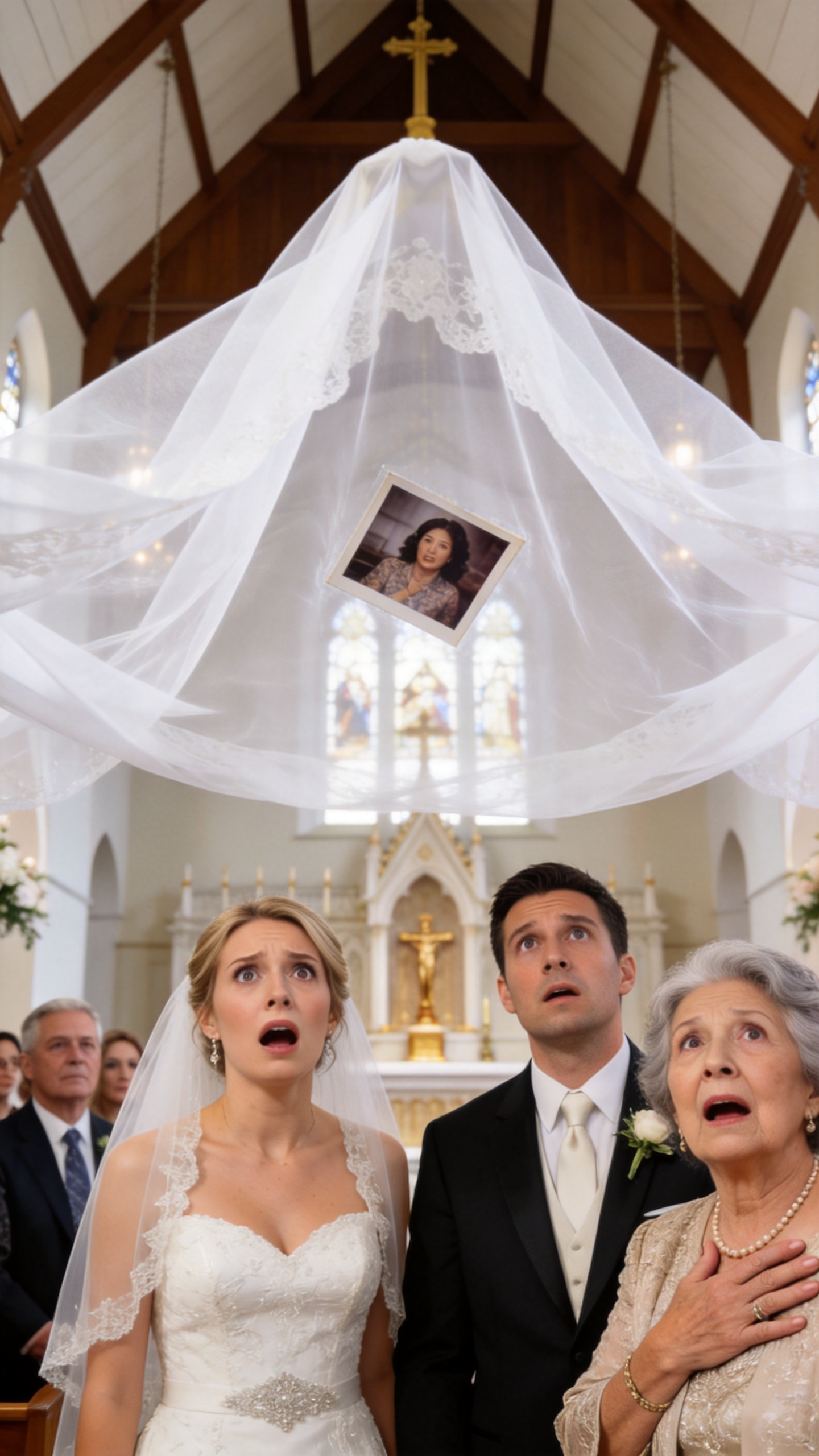
The Slap Echoed Across The Prescott Ballroom, Then My Father Walked In With Twelve Black Folders And Froze The Empire That Had Laughed At Me
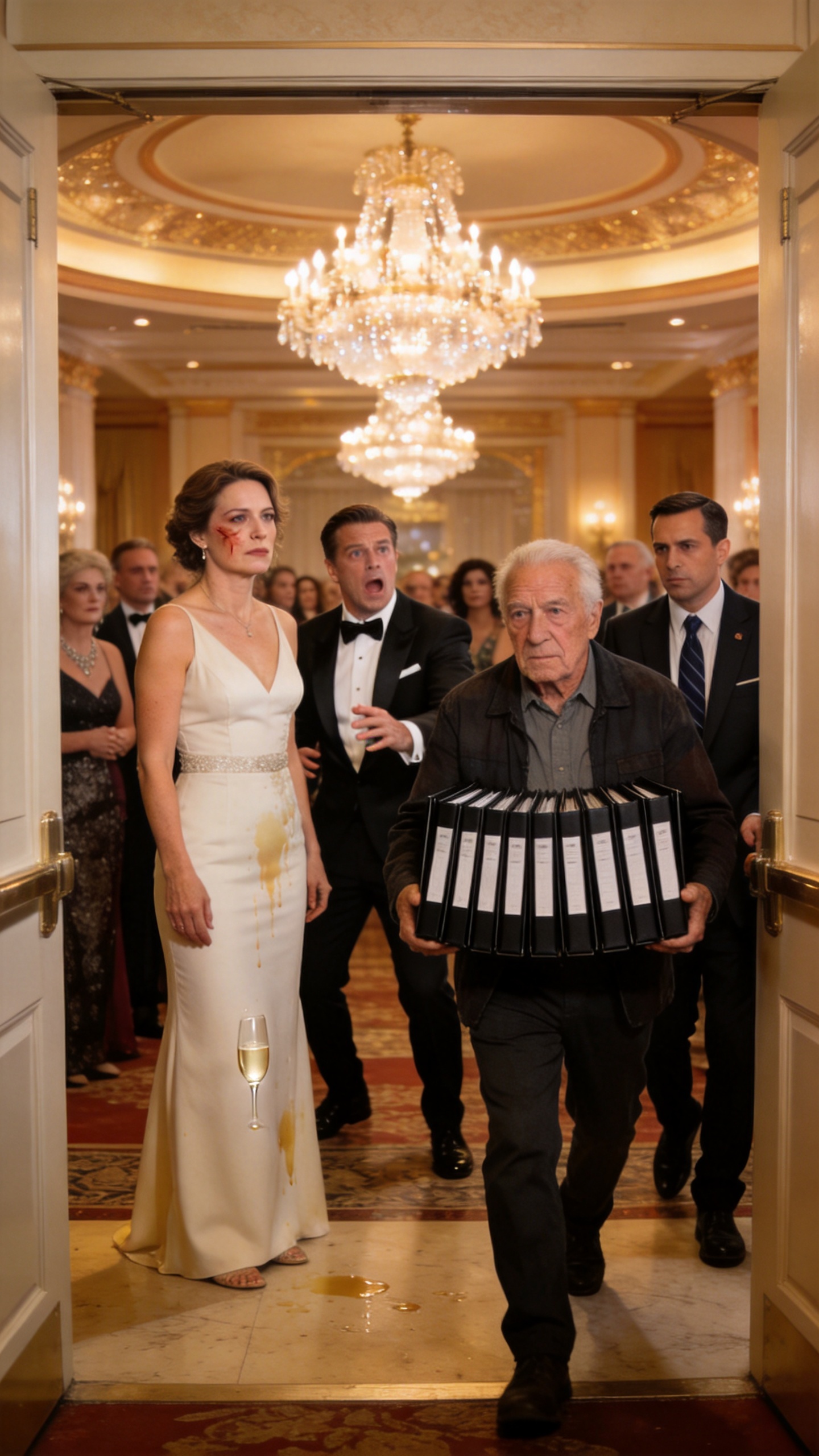
The Ballroom Laughed Because Randolph Laughed First
The slap echoed like a verdict across the crystal-lit ballroom.
For one extraordinary second, the world did not move.
Five hundred guests stood beneath chandeliers bright enough to imitate daylight, their jeweled throats and polished cuff links gleaming in the frozen silence. The orchestra's final note trembled above the dance floor, thin and unfinished. A waiter stopped with a silver tray tilted in his hands. A senator's wife lifted her fingers to her mouth. Somewhere near the champagne fountain, a glass slipped and shattered.
My cheek burned.
The taste of blood mingled with the champagne Randolph Prescott had thrown into my face moments before striking me. It was metallic, bitter, and strangely clarifying.
Randolph stood inches away, breathing hard, his handsome features rearranged by rage. The ballroom lights glittered in his eyes, making them appear almost beautiful.
That was the most dangerous thing about him.
Even at his ugliest, the world had trained itself to admire him.
"Look at her," he said, turning toward the guests. "Still pretending she belongs here."
A few people laughed.
Not because the joke was funny.
Because Randolph Prescott had laughed first.
Power always taught people when to laugh, when to look away, and when to call cruelty sophistication.
I touched my lower lip. Blood stained my fingertip.
Randolph saw it and smiled.
"You should be grateful," he continued. "Five years ago, you were balancing invoices in a windowless office. Then I married you. I gave you a name, a home, a life people would kill for."
"A life people have killed for," I said.
His smile flickered.
Only for a moment.
Then he leaned closer, lowering his voice. "Do not start speaking in riddles, Mara. You're not clever enough to frighten me."
That almost made me laugh.
For five years, I had corrected the company's cash-flow projections while Randolph took credit. I had prevented three acquisitions from collapsing, renegotiated debts he did not understand, and quietly stopped Prescott Holdings from violating banking covenants that would have destroyed it.
At dinner parties, he introduced me as his "little numbers girl."
In board meetings, he repeated my conclusions in a deeper voice.
And in private, whenever my usefulness reminded him of his inadequacy, he punished me for it.
Tonight's gala was supposed to celebrate the hundredth anniversary of Prescott Holdings.
Instead, Randolph had spent the evening flirting openly with the daughter of a foreign minister, insulting my dress, and telling anyone who listened that I possessed "all the warmth of an accountant's spreadsheet."
An hour earlier, as we sat beneath the gold-leaf ceiling, he had looked at me and said, "You know what your problem is?"
"I suspect you're about to tell me."
"You always look as though you're calculating something."
I had smiled.
I was.
Every offshore transfer.
Every falsified ledger.
Every shell company disguised as a charitable foundation.
Every politician who received consulting fees for services never performed.
Every employee whose pension had been raided to cover Randolph's gambling losses.
For five years, I had studied every crack in the Prescott empire.
And tonight, at last, they had handed me the hammer.
I removed my phone from my clutch.
Randolph's laughter returned. "What are you going to do? Call the police?"
"No."
I tapped a number I had memorized as a child.
My father answered on the first ring.
"Mara?"
His voice was rough and familiar, carrying memories of oil-stained hands, burnt coffee, and the small repair shop where I had grown up.
I looked directly at Randolph.
"Dad," I said, my voice unnervingly calm. "Come get me."
Silence filled the line.
My father understood what those words meant.
We had agreed on them years ago.
Not because I expected to be struck in public, but because men like Randolph often revealed themselves only when they believed no consequences remained.
"Are you certain?" my father asked.
I looked around the ballroom.
At the executives whose bonuses I had protected.
At the women who had watched Randolph humiliate me and then turned toward the dance floor.
At the members of the Prescott board who knew I had saved the company and still referred to me as "Randolph's practical little wife."
"Yes," I said.
Then I added the words that would end an empire.
"Bring everything they never saw coming."
I lowered the phone.
Randolph stared at me for half a second before throwing back his head and laughing.
"Your father?" he said. "You called your father?"
The ballroom joined him cautiously.
Randolph stepped onto the raised edge of the dance floor and spread his arms.
"Ladies and gentlemen, we are about to be rescued by Silas Vale, proprietor of the most unsuccessful truck garage in the state."
More laughter.
"Perhaps he'll arrive in that rusted pickup of his," Randolph continued. "The one that sounds like a washing machine full of nails."
I wiped the blood from my lip.
"You should have looked more closely at the truck."
Randolph's father emerged from the crowd.
Augustus Prescott was seventy-one, silver-haired and broad-shouldered, with the weary grandeur of a deposed king. He had spent four decades appearing on magazine covers beneath headlines about discipline, vision, and legacy.
Tonight, he looked older than I had ever seen him.
"Mara," Augustus said quietly, "you should leave."
Randolph turned toward him. "This has nothing to do with you."
"It has everything to do with me."
Something passed between them.
Fear, perhaps.
Or recognition.
Randolph did not notice. He rarely noticed anything that was not reflected in a mirror.
His mother did.
Celeste Prescott sat near the center of the ballroom beneath an enormous oil portrait of herself.
She was sixty-eight and almost unnaturally elegant, dressed in pale silver with diamonds at her throat. Her white-blond hair framed a face the newspapers called timeless. For three decades, she had chaired hospitals, opened museums, funded shelters, and posed beside children whose names she never remembered.
She had not moved when Randolph struck me.
She had merely lifted her champagne glass and watched.
Now her gaze shifted from Augustus to me.
A small movement.
A small suspicion.
Then the ballroom doors groaned open.
The laughter died first.
Randolph's smile followed.
My father stepped into the light.
He wore the same faded blue work shirt he had worn that morning. The cuffs were rolled above his wrists. A streak of grease marked one sleeve.
But the watch beneath that sleeve was worth more than Randolph's mansion.
Behind him came twelve people in dark suits, each carrying a sealed black folder. Some wore federal identification badges. Others carried court orders, forensic drives, and evidence cases.
At the center walked a woman with silver hair and the expression of someone arriving to collect a debt.
I recognized her immediately.
Justice Miriam Quill had spent twenty-eight years on the federal bench. She had dismantled monopolies, imprisoned governors, and once forced a banking dynasty to repay every cent stolen from three generations of farmers.
She had retired two years earlier.
Or so the public believed.
Randolph gripped his champagne glass.
"Who let you in?"
My father glanced at me before answering.
"The same person who owns this building."
A murmur moved through the ballroom.
Randolph laughed, but the sound cracked in the middle.
"This building belongs to Prescott Holdings."
Justice Quill opened her folder.
"It belonged to Prescott Holdings until 4:17 this afternoon."
She placed a document on the nearest table.
The Prescott crest stared upward from the page like a tombstone.
"Following the acceleration of secured debt, material breaches of fiduciary duty, and emergency findings issued by the court," she said, "this property is now under receivership."
Augustus closed his eyes.
Celeste did not move.
My father crossed the marble floor and stopped beside me.
For the first time that night, my control nearly broke.
His fingers trembled as they touched my bruised cheek.
Not the tremor of an old man.
The tremor of a father imagining every moment that had led to this one.
"I should have come sooner," he whispered.
"You came when I called."
"I should never have let you stay."
"I chose to stay."
Pain moved across his face.
Then he turned toward the room.
The mechanic disappeared.
In his place stood the man Randolph had never bothered to see.
"Effective immediately," my father announced, "all Prescott operating accounts, subsidiary accounts, trusts, and charitable foundations are frozen."
Someone dropped another glass.
This time, no one laughed.
A banker near the eastern doors slipped his phone into his pocket and began moving toward the exit.
Two federal agents stepped into his path.
"Remain in the room, please."
The doors locked.
Augustus pushed through the crowd, his face red with an emotion I could not yet name.
"You cannot freeze my company."
I looked at him.
For five years, I had wondered what I would feel when this moment came.
Triumph?
Revenge?
Relief?
Instead, I felt only exhaustion.
"It was never your company," I said.
I lifted my phone and tapped the screen.
Every chandelier went dark.
Gasps swept through the ballroom.
Then the walls illuminated.
The gold draperies became projection screens. The portraits vanished beneath columns of numbers. Bank transfers, forged signatures, shell corporations, property deeds, encrypted messages, and photographs surrounded the guests.
Five years of secrets turned the ballroom into an exhibit.
A map appeared, connecting Prescott subsidiaries to accounts in Zurich, Singapore, Malta, and the Cayman Islands.
Then came the recordings.
Randolph's voice filled the room.
The pension fund is just dormant capital.
A second clip followed.
Those factory workers won't know the difference. Half of them can barely read a pay stub.
Then another.
Pay the inspector. If he won't take it, find someone with photographs of his daughter.
Randolph's face drained of color.
His champagne glass slid from his hand and struck the marble.
"You recorded me?"
"No," I said.
I looked past him.
"Your father did."
The room turned toward Augustus.
The Folders Arrived Before The Empire Could Breathe
He stood perfectly still.
Then, with slow precision, he removed his cuff links and placed them on a table.
Randolph stared at him.
"You?"
Augustus looked at his son, and something inside him seemed to collapse.
"I gave you every chance to stop."
"You betrayed me."
"I documented you."
"You're my father."
"Yes," Augustus said. "That is why it took me so long."
Randolph crossed the floor and grabbed his father's lapels.
Agents moved forward, but Augustus raised one hand.
"No," he said. "Let him look at me."
Randolph's breathing became ragged.
"You weak, senile coward."
Augustus did not defend himself.
"You taught me this," Randolph hissed. "You taught me that winning was the only thing that mattered."
"No," Augustus said. "I taught you what I had been taught. That was my failure."
Randolph released him with a shove.
"You think confessing makes you noble?"
"No."
"Then what does it make you?"
Augustus looked toward the financial records burning across the walls.
"A witness."
My father opened the final black folder.
Inside was a photograph of two young men standing in front of an unfinished warehouse.
One was Augustus.
The other was my father.
The date printed in the corner was thirty-two years old.
Across the bottom, someone had written three words in red ink.
SHE MUST NEVER KNOW.
I looked at my father.
He was not watching Randolph.
He was looking at me.
And for the first time that night, fear entered his eyes.
"Dad?" I whispered.
His gaze shifted briefly toward Celeste.
Then back to me.
The movement was almost imperceptible.
But I understood.
The message was not what everyone thought.
Not yet.
Celeste rose gracefully from her chair.
"What a fascinating performance," she said.
Her voice carried across the ballroom without effort.
The projections painted shifting numbers across her silver gown.
She walked toward the photograph.
"Thirty-two years," she murmured. "How sentimental."
Augustus's face tightened.
Celeste picked up the photograph.
"Silas Vale and my husband. Partners."
Randolph turned toward her. "You knew?"
"Of course I knew."
The response came too quickly.
My father's hand closed around mine.
Celeste examined the red writing.
"She must never know," she read. "Obviously, they meant Mara."
"No," I said.
Celeste looked at me.
I tasted blood again.
"They meant you."
The silence changed.
Before, it had been shock.
Now it became danger.
Randolph shook his head. "What is she talking about?"
Celeste smiled.
Not the gracious smile from magazine covers.
Not the soft expression she wore at children's hospitals.
This smile was small, private, and empty.
Augustus spoke first.
"Prescott Holdings began with three people."
One of the ballroom screens changed.
An old partnership agreement appeared.
Silas Vale.
Augustus Prescott.
Celeste Armand.
"My father and Augustus designed the logistics network," I said. "But Celeste designed the financial structure."
Randolph looked between them. "So?"
"So she discovered something," my father said. "Companies do not need to be profitable to make their owners rich. They only need to move money."
The screens displayed early ledgers.
Shipping invoices doubled and tripled.
Nonexistent cargo.
Phantom warehouses.
Insurance claims filed for goods that had never existed.
"Celeste wanted to expand," Augustus said. "Political payments. Smuggling routes. Pension theft. Anyone who resisted became a liability."
Celeste sighed.
"You always did make business sound so vulgar, Augustus."
"You ordered a warehouse foreman killed."
"He threatened six thousand jobs."
"You had him thrown from a bridge."
"I preserved the company."
Randolph stared at his mother.
For the first time, I saw a child beneath the cruelty. A frightened boy discovering that the monster under his bed had been the person who tucked him in.
"You told me Dad built all this," he said.
Celeste turned to him.
"Your father liked magazine covers."
Augustus flinched.
"Your mother built the empire," I said. "Your father spent thirty-two years pretending he controlled it."
"That's impossible."
"Is it?"
Another recording began.
Celeste's voice filled the room.
Calm. Cultured. Unmistakable.
Augustus is useful because men prefer fearing other men.
A second recording followed.
Randolph can sign the pension transfer. If anyone investigates, an ambitious son stealing from his father is a story the public will understand.
Randolph staggered backward.
His mother watched him without expression.
"You were going to blame me."
"I was going to protect what I built."
"I'm your son."
"You are an appetite wearing a dinner jacket."
The cruelty of it struck even me.
Randolph had humiliated, threatened, and struck me. He had destroyed careers for sport.
Yet in that moment, I understood what had made him.
Not an excuse.
An origin.
Celeste had fed his worst instincts because they made him noisy. Predictable. Useful.
He had believed himself the heir.
He had always been the decoy.
Justice Quill stepped forward.
"Celeste Prescott, you are being detained pending charges including conspiracy, money laundering, obstruction of justice, bribery, wire fraud, pension theft, and solicitation of murder."
A federal marshal approached.
Celeste's smile returned.
"Am I?"
Her right thumb pressed against the emerald ring on her finger.
My father's face changed.
"Mara!"
The screens went black.
Emergency lights flashed red.
A mechanical sound thundered behind the walls as steel shutters descended over the ballroom windows.
Guests screamed.
Justice Quill shouted orders.
Celeste moved with startling speed, seizing a champagne bottle and smashing it against the table. She pressed the jagged glass to the throat of the foreign minister's daughter.
"Open the west corridor," she said.
The young woman whimpered.
Randolph stood motionless.
"Mother..."
Celeste did not look at him.
"Open it."
A security officer near the wall hesitated.
Celeste tightened her grip. A thin line of blood appeared on the hostage's neck.
"Now."
The officer entered a code.
A section of the ballroom wall opened, revealing a service passage.
Celeste dragged the young woman toward it.
My father stepped in front of me.
"Stay back."
But I had not spent five years waiting to stand behind anyone.
"White Orchard," I called.
Celeste stopped.
The words struck her more effectively than a bullet.
Slowly, she turned.
"How do you know that name?"
"Your emergency protocol," I said. "The system that destroys the company archives, transfers the reserve funds, and sends copies of your private insurance files to three foreign attorneys."
Her eyes narrowed.
"That information existed only on an isolated server."
"In the lake house."
"No one entered that room."
"I didn't need to."
I reached beneath my dress and removed a thin gold chain.
A tiny black key hung from it.
Celeste's composure cracked.